Cameroon / Kribi refinery: Early production launch to achieve energy self-sufficiency
Driven by a consortium uniting the National Hydrocarbons Corporation (SNH), Tradex, and Ariana Energy, the company Cstar Petroleum is preparing a crucial step for the energy independence of Cameroon.
It is planning a partial start-up of its refinery under construction at the port of Kribi as early as the second half of 2026, according to an “accelerated production” schedule presented to its board of directors in December 2025.
This initial phase targets a capacity of 10,000 barrels per day, approximately one-third of the final 30,000 barrels per day capacity, enabling it to meet nearly 22% of national demand for diesel and gasoline.
This operational acceleration, if confirmed, would redefine the project’s timeline, initially envisioned for full commissioning in June 2028. It illustrates the strategic will to quickly address a glaring deficit.
In a context where annual demand is estimated at 1.9 million tons, the country largely depends on imports following the halt of operations at SONARA.
The Kribi complex, with a projected cost of 115 billion CFA francs, therefore aims to be a pillar of “energy sovereignty.”
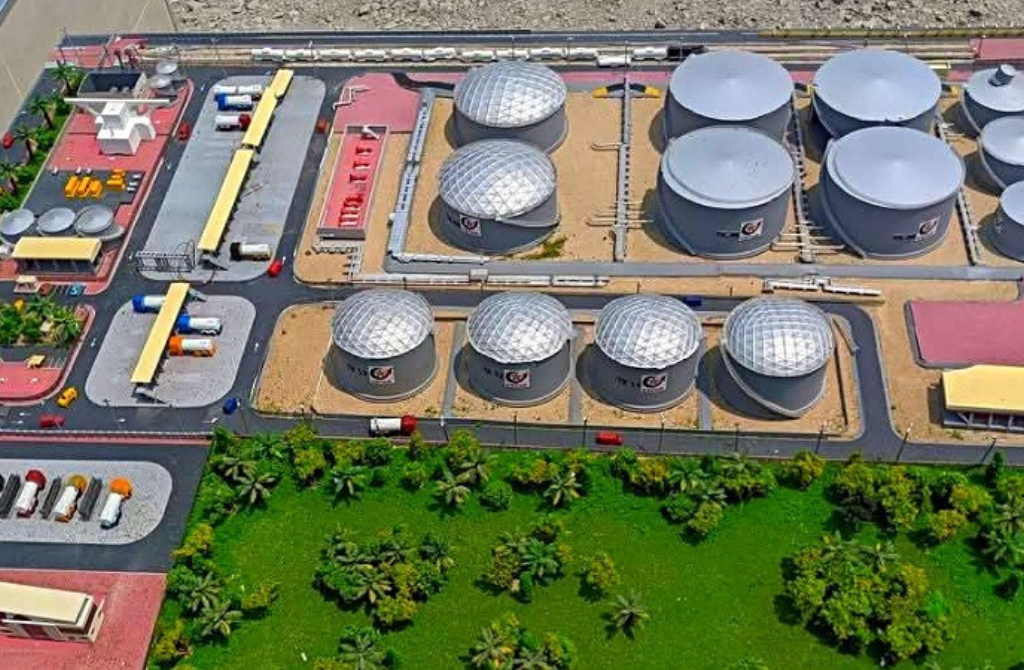
Announced for a 250-hectare site, the project combines a refinery and a storage terminal of approximately 250,000 cubic meters.
The construction work, entrusted to a consortium led by RCG Turnkey Solutions, is expected to enter its operational phase in January 2026, according to a Cstar communication.
The financial arrangement, with BGFI Cameroun acting as the agent bank, aims to mobilize 120 billion CFA francs.
The economic ambitions match the scale of the stakes. The promoters project a 30% reduction in imports, generating annual savings approaching 400 billion CFA francs, as well as export revenues estimated at 141 billion.
The project also promises the creation of 2,000 direct and 5,000 indirect jobs. Structured around two entities Cstar Tank Farm for storage and Cstar refinery for processing the complex aims, at full capacity and with biofuel units, to cover nearly 70% of local needs.
Thus, the Kribi refinery is not just another energy infrastructure project; it embodies an industrial and economic trajectory.
Its accelerated start-up in 2026 would symbolize a first concrete victory in the long journey of Cameroon toward strategic autonomy in petroleum products, reducing its vulnerability to international market fluctuations and strengthening its economic resilience.
Jean-Robert Tchandy