DRC: EU-AU Summit, President Félix Tshisekedi calls for a renewed partnership
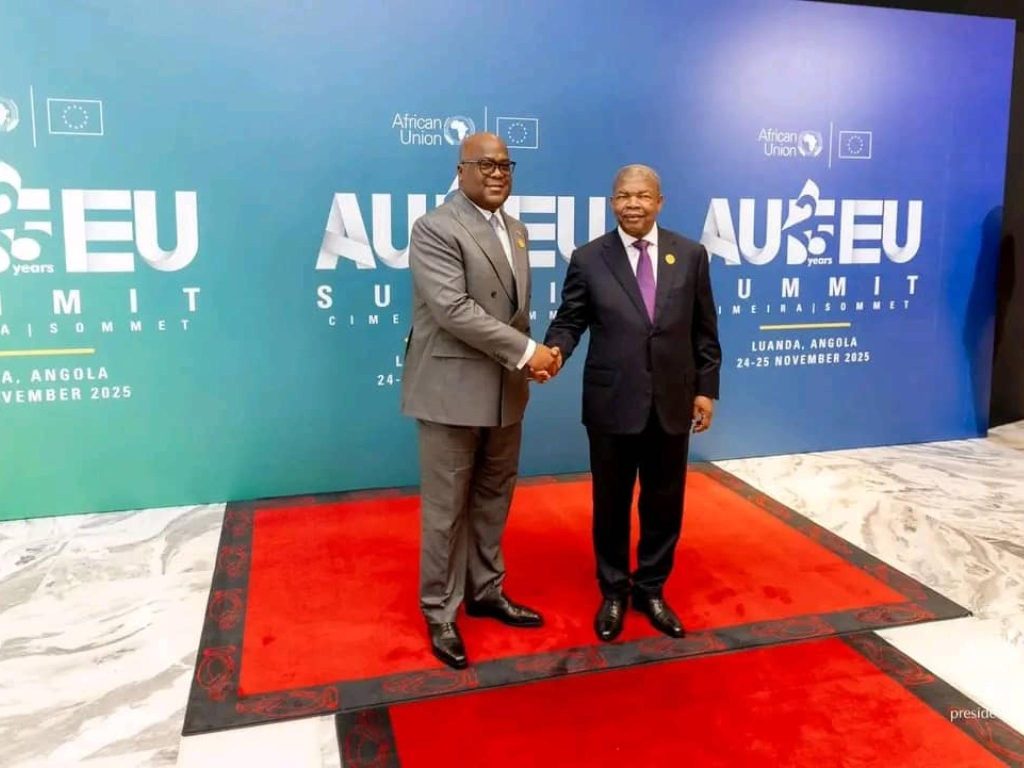
At the 7th Summit of Heads of State and Government of the European Union and the African Union, held this Monday in Luanda, Angola, the President of the Democratic Republic of Congo, Félix Antoine Tshisekedi Tshilombo, delivered a notable address calling for a profound and clear-eyed overhaul of relations between the two continents.
Under the theme “Promoting Peace and Prosperity through Effective Multilateralism,” the summit provided a platform for the Congolese leader to present an unflinching assessment of twenty-five years of partnership.
President Tshisekedi framed the necessity for this evaluation, describing the meeting as a triple imperative: a “moment of assessment,” a “moment of truth” to identify failures, and above all, a “moment of projection” towards a more balanced common future.
He insisted on the need to measure the concrete impact of this partnership on the daily lives of African populations, an evaluation that must be conducted with unwavering clarity.
At the heart of his plea was the urgency of security. He firmly reiterated that any ambition for economic prosperity, trade, or investment is conditional upon the prior establishment of peace and security.
“Peace and security have become vital urgencies,” he declared, pointing to the crises shaking the continent.
Without explicitly naming actors, he referenced the situation in his own country, where the sacrosanct principles of sovereignty and territorial integrity are “severely tested,” denouncing repeated violations of the principles of non-interference and non-use of force that underpin the continental order.
Despite this stern assessment, the Congolese President did not yield to pessimism. He forcefully reaffirmed his faith in multilateralism, which he hopes will be reformed and revitalized.
His advocacy focused on the necessity of building an international system based not on the law of the strongest, but on clear, impartial rules respected by all. He demanded cooperation founded on transparency and active solidarity, capable of supporting peoples whose fundamental rights are being trampled.
Ultimately, President Tshisekedi’s intervention transcended the specific case of the DRC to present a demanding yet constructive African voice.
It served as a reminder that the future of the EU-AU partnership will not be built on declarations of intent, but on the recognition of past failures, a concrete response to present urgencies, especially regarding securityand the joint construction of a multilateralism that finally delivers on its promises of justice and equity for all partners.
Paul FOCAM