Mali: Transitional President His Excellency General Assimi GOÏTA in Tatarstan
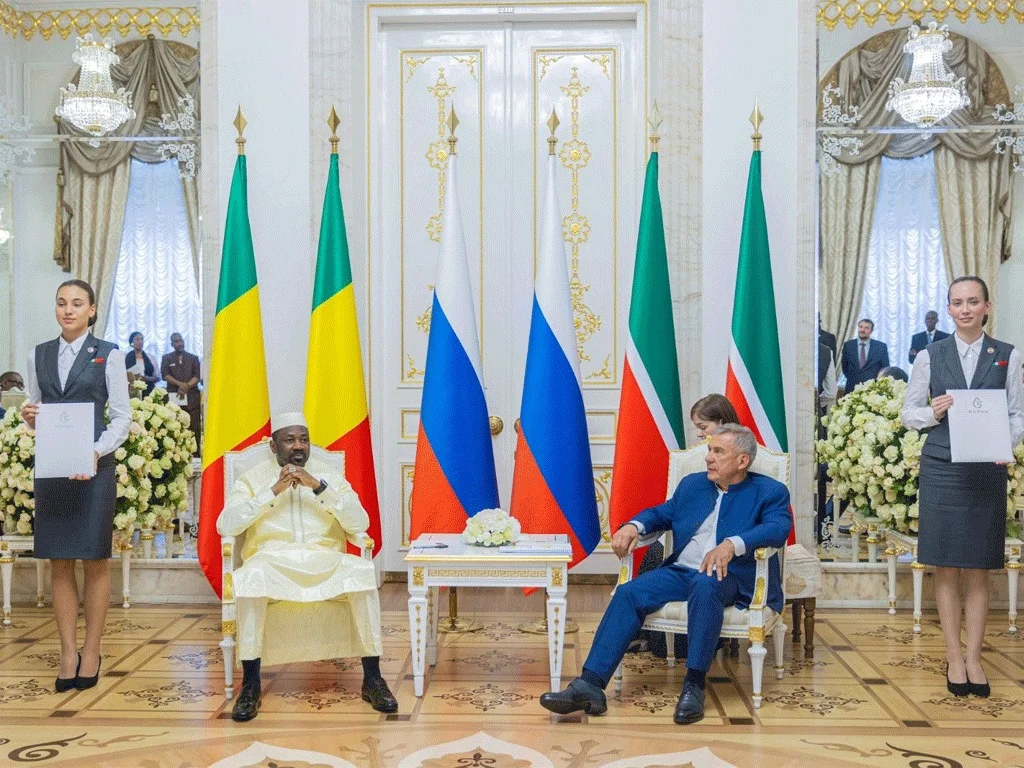
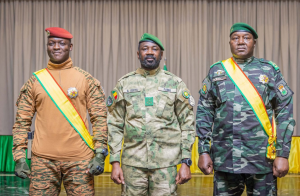
His Excellency General Assimi GOÏTA, President of the Transition, is continuing his official visit to the Russian Federation with a stop in Kazan, the capital of the Republic of Tatarstan, where he received a warm welcome from His Excellency Rustam Minnikhanov NURGALIYEVICH, President of the Republic.
The visit included a one-on-one meeting between the two Heads of State, followed by an expanded session with members of both delegations. These discussions provided an opportunity to review the current state of cooperation between Mali and the Russian Federation, with particular emphasis on the potential role of regional partners such as Tatarstan in strengthening bilateral ties.
President NURGALIYEVICH expressed his deep gratitude to President GOÏTA for visiting Tatarstan, calling it a significant milestone in deepening the bond between their peoples. He praised the dynamic cooperation between Mali and Russia, which spans over six decades, particularly in the fields of education, defense, and security. He outlined key areas for future collaboration, including energy, mining, infrastructure, agriculture, fisheries, industrial processing, innovation, and machinery. He also highlighted the presence of the Yadran company in Mali, which has begun construction of a gold refinery—signaling the start of a promising industrial partnership. Furthermore, he invited greater Malian participation in the annual Kazan Islamic Economic Forum, which attracts thousands of participants from over 80 countries.
In response, President Assimi GOÏTA thanked the authorities and the people of Tatarstan for their warm hospitality. He underscored the deep historical ties between Mali and the Russian Federation and emphasized the strategic importance of their cooperation in defense and security, especially in light of the ongoing fight against terrorism.
The Head of State expressed Mali’s desire to expand cooperation into other key development sectors such as infrastructure, energy, trade, and transportation. He noted that his delegation includes several government ministers to facilitate the signing of key bilateral agreements in mutually beneficial areas. He also expressed hope that the discussions would lead to concrete commitments before the end of his visit—particularly by establishing direct links between technical ministries to accelerate the implementation of agreed projects.