Burkina Faso: Captain Ibrahim Traoré relies on young people to feed the nation

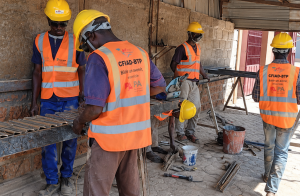
In Burkina Faso, the agricultural issue has changed in status. It is no longer just a matter of rural survival or peasant tradition. It is becoming a central political axis, fully embraced as such by the transitional authorities. The monitoring mission conducted by the National Bureau of Major Projects of Burkina in sixteen training centers illustrates this direction.
Three thousand young people have completed an intensive agricultural training cycle as part of the Presidential Initiative for Agricultural Production and Food Self-Sufficiency.
These technical sessions reflect the vision championed by President Ibrahim Traoré: that of rebuilding national sovereignty starting from the land.
In Bissiri, at the Rural Promotion Center, one hundred and fifty trainees are experiencing this policy firsthand. The plots of corn, cowpea, and sorghum are not merely pedagogical exercises.
They embody a shift in perspective on agriculture. The young people learn to restore soils, organize agricultural space, and understand production cycles.
Techniques such as half-moons, stone bunds, and earthen dikes demonstrate agronomic knowledge adapted to the realities of the Sahel.
This approach reveals a powerful idea. Food self-sufficiency cannot be proclaimed from administrative offices. It is patiently built in the fields, through the transfer of skills and the mobilization of youth.
The training goes beyond simple production. Trainees also learn to process and preserve harvests.
Peanut paste, papaya jam, pineapple syrup, or traditional beverages. Behind these products lies a stronger rural economy, capable of reducing losses and creating local value.
What is particularly striking about this initiative is the transformation of mindsets. Several young people recount arriving with the idea that there was no future in Burkina Faso.
After a few months of training, their perspective changes. They discover that work exists, provided they master the techniques and add value to local resources.
The active participation of women further strengthens the impact of this dynamic. Their presence in these centers heralds a more inclusive agriculture, where food sovereignty also becomes an issue of social emancipation.
The goal of training eight thousand agricultural entrepreneurs across the entire territory reflects a clear strategy: to produce more, process locally, and anchor youth in the national economy.
In a Sahel too often described through its crises, Burkina Faso is attempting to impose another narrative.
That of a country that understands that sovereignty begins with mastering what is sown, cultivated, and processed.
For a nation that feeds its people already holds in its hands an essential part of its freedom.
Cédric KABORE