Togo: Industrial ambition in full swing – how Faure Gnassingbé’s vision is propelling ‘Made in Togo’ onto the international stage
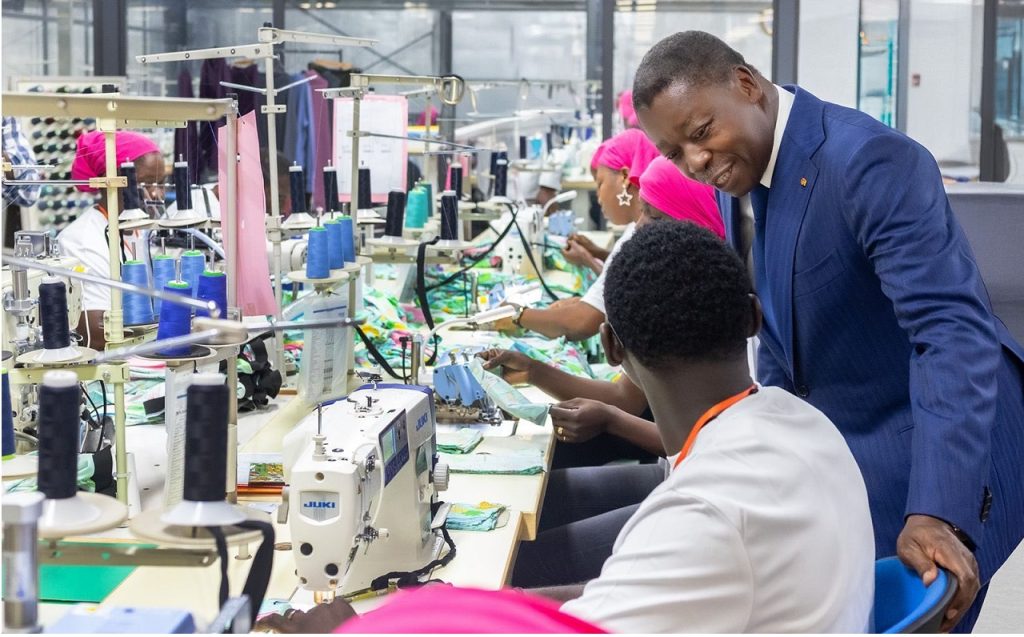
Togo is undergoing a major industrial transformation. The era when the country simply shipped raw commodities to other continents is ending. Under the leadership of President of the Council Faure Gnassingbé, Lomé has made a strong political choice: local processing. The engine of this transition has a name: The Adétikopé Industrial Platform (PIA), a space where the country’s economic future is now being written.
The latest figures published by the PIA Coordination Authority prove that this economic strategy is beginning to pay off. In 2025, the platform’s factories exported 210,000 garments and textile products directly to the United States.
This production volume reveals a concrete reality: Togolese cotton is no longer merely harvested it is spun, woven, and assembled on site before traveling abroad.
This is precisely the integrated value chain that the President of the Council sought to build, in order to free the country from dependence on global raw commodity prices.
This momentum is accelerating thanks to international investors who have found in Togo the stability guarantees needed for long-term establishment.
The arrival in 2025 of Star Garments, a subsidiary of the American group Charles Komar & Sons, is concrete proof of this scaling up.
With an investment of nearly 13 billion CFA francs, this factory marks the group’s first installation outside Asia.
If such a giant chooses to settle in Adétikopé to supply major American retailers, it is because the modernization reforms undertaken by the executive have made the site competitive.
The positioning is resolutely offensive. By leveraging the customs advantages of AGOA and the logistical efficiency of the Autonomous Port of Lomé, Togo demonstrates that it can compete internationally, even in a more complex global customs environment.
The early successes, such as the shipment of 123,000 garments for the brand The Children’s Place, were not a stroke of luck, but the beginning of a regular and structured flow.
Five years after its launch, the PIA’s track record validates the presidential orientations: 350 billion CFA francs in cumulative investments, 25 partner companies, and above all, 6,580 direct jobs created, 95% of which are held by Togolese nationals.
The social impact is immediate for these thousands of families. The second phase of development, which targets 50 industrial units, aims to create over 10,000 additional jobs, with a target set between 15,000 and 20,000 jobs by 2030.
By imposing this shift, Faure Gnassingbé makes the pragmatic choice: integrating Togo into globalization through value addition and local employment.
Chantal TAWELESSI