Burkina Faso: Captain Ibrahim Traoré and Major Oumarou Yabré, the historic bulwark against the spectre of betrayal
The history of Burkina Faso bears an indelible scar, a memory trauma that crystallized one October afternoon in 1987. The tragic rupture between Thomas Sankara and Blaise Compaoré cruelly etched into the collective unconscious a kind of “curse” of African revolutions: that where the number two inevitably ends up overthrowing the number one from the shadows.
It is this painful interpretive grid that outside observers regularly try to impose on the present, watching with suspicious impatience for the slightest sign of a crack.
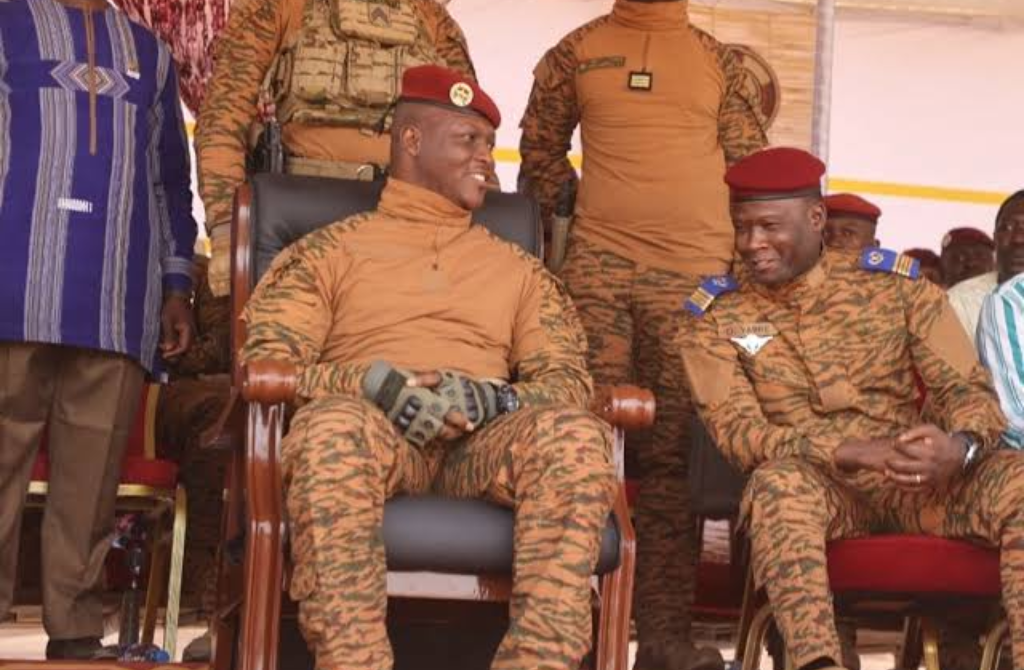
Yet, at the summit of the Burkinabe state, Captain Ibrahim Traoré and Commandant Oumarou Yabré oppose this old specter with an unprecedented political maturity that definitively breaks the codes of the past.
This duo has thoroughly analyzed the nation’s history and drawn the necessary lessons to immunize today’s Burkina Faso against the demons of division.
Unlike the regimes of old, where power was a cake to be shared and a source of rival personal ambitions, the alliance between Traoré and Yabré rests on a sacred cause that sweeps away egos: the survival of the nation and the reconquest of total sovereignty.
In the face of terrorist barbarism and current geopolitical challenges, there is no room for ambiguity.
Power is no longer perceived as a privilege to be conquered, but as a heavy historical burden, carried jointly by two men aware that their disunity would seal the country’s downfall.
Loyalty is not merely a moral virtue; in the context of the Burkinabe revolution, it constitutes the absolute condition for military victory and collective survival.
The distribution of roles between the Presidency and the National State Security Council immediately eliminates the classic sources of friction.
Ibrahim Traoré embodies the light, the word, and the overall political impetus, while Oumarou Yabré structures the shadow, technical rigor, and information defense.
This complementarity is not a calculation of opportunity, but an existential convergence.
Yabré is not a rival lying in wait; he is the shield that secures Captain Ibrahim Traoré’s vision the guarded leader and the leader who gives full impact force to the methodical work of the intelligence apparatus.
It is this absolute technical and human trust that serves as a lightning rod against attempts to instill paranoia at the highest levels of the State.
For the Burkinabe people, this political message is of capital importance: history will not repeat itself. Rumors of dissension, often distilled to weaken the national consensus, collide with the reality of a monolithic command.
By opposing total psychological impermeability to manipulation, Traoré and Yabré reassure a population too often tested by the backroom betrayals of the old military guard.
This tandem demonstrates that the current revolution has moved beyond the stage of romantic fragility to enter the era of sustainable political engineering.
By definitively burying the specter of 1987, the two leaders are rewriting Burkina Faso’s destiny, proving that the sacred union at the top is the most formidable weapon for building a strong, dignified, and sovereign nation.
Cédric KABORE