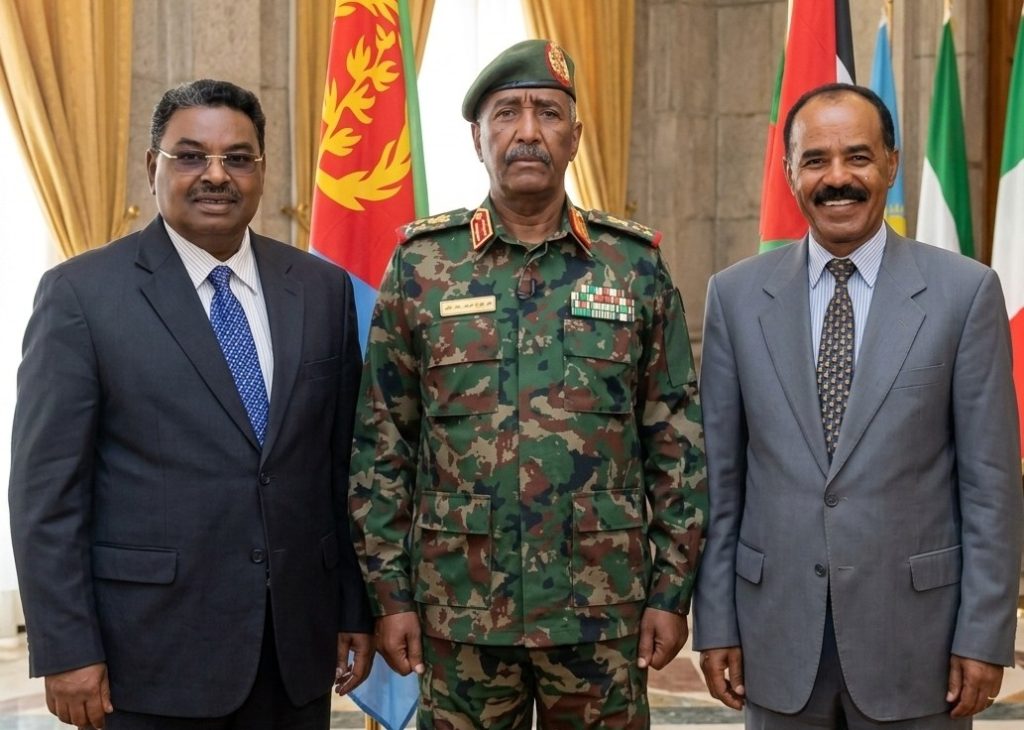
Al-Burhan and Gosh hold secret talks in Asmara with Egyptian-Eritrean coordination
Asmara – Afri News
Reliable intelligence has revealed the details of a plan orchestrated behind the scenes last week in Asmara, the Eritrean capital. This secret meeting brought together the Chairman of the Sovereignty Council, Abdel Fattah al-Burhan, and the former director of the National Intelligence and Security Service, Salah Abdullah “Gosh,” amid full Egyptian-Eritrean coordination. The details of this meeting clearly illustrate how the war in Sudan has become a theater of influence where personal interests and power dynamics between military leaders and armed movements clash, at the cost of Sudanese lives and the suffering endured by the Sudanese people.
According to available information, the meeting resulted in an elaborate military-political plan, divided into three main phases. These phases aim to restore the military wing of the Muslim Brotherhood and consolidate the ruling regime by gradually eliminating its allies.
Details of the plan: Exploiting contradictions and exhausting allies
Phase 1: Securing the Kordofan Axis with New Artillery Weapons
The initial stages of implementation involved accelerating military operations to drive the Rapid Support Forces out of North Kordofan. The axis has already seen a massive influx of military vehicles and heavy equipment in the areas of Al-Rahad and north and east of Umm Sayala, coinciding with a significant military reinforcement of the 18th Division in Kosti.
In the past two days, the army, backed by its forces, has made significant progress and has managed to open the export route, facilitating the movement of soldiers and troops from Omdurman to the Kordofan plain. The arrival of heavy equipment on the ground has shifted the balance, notably thanks to the M777 howitzer provided by Saudi Arabia.
Increased support was achieved through the transfer of sufficient military equipment for one month of operations to the positions of Al-Rahad and Al-Ubayyid, as well as the mobilization of vehicles stored at the 10th Division in Abu Jubayhah. This enabled the army to open the export route and transport troops from Omdurman to the Kordofan plain.
Phase 2: Betrayal of alliances and weakening of the Minawi movement
This phase reveals the exclusionary mindset that characterizes the management of operations. The general staff has devised a plan aimed at weakening the Darfur movements, and more specifically the Sudan Liberation Army (SLA) led by Minni Arko Minawi, under the slogan “March toward the liberation of Darfur.”
The reality on the ground confirms that the objective is to break the military power of Minawi’s forces in order to prevent any future political blackmail, given the significant differences in vision though unspoken between him and Burhan, differences that military intelligence services have observed and feared.
Conversely, the plan provides for maintaining the forces of Jibril Ibrahim and Mustafa Tambour, as they are closest to the Islamist wing within the army and would not oppose Burhan’s accession to the presidency. As a result, operations in Kordofan were swift and limited to controlling only North Kordofan, without any real intention of advancing westward toward Darfur.
Phase 3: The political coup and the war Government
This complex phase aims to shape the upcoming political landscape by forming political blocs that swear absolute loyalty to Burhan. These entities work to:
1- Push through an agenda to abolish the current Sovereignty Council.
2- Replace the Council with a “war government,” a preliminary step toward rigged elections that would ensure the ruling group remains in power.
3- This is being implemented through intensive communication with the leaders of the Democratic Bloc and certain resistance groups, as well as by recruiting activists in the public sphere to rally public opinion to their cause.
Ports and normalization with the Islamists: Secret agreements
The Asmara meeting was not limited to military planning; it also addressed domestic and regional affairs. The meeting reaffirmed the need to end tensions between the army and the leaders of the Islamist movement, as their presence constitutes a fundamental threat and a counterbalance to Minawi’s power on the ground.
On the economic front, Burhan concluded agreements with Eritrean President Isaias Afwerki to expand the activities of the “Red Sea Company,” which operates in the coastal and eastern states of the country.
Despite its commercial nature, focused on import-export, it is above all an intelligence platform aimed at reconciling security and economic interests.