Burkina Faso: When fear switched sides!
There is a form of courage that is not seen on the battlefields that of mothers rebuilding a life after fleeing their village, that of teachers reopening a classroom in a threatened locality, that of artisans refusing to close up shop despite the fear. This courage, silent and every day, is the bedrock upon which Burkina Faso’s resistance rests in the face of a war that knows no respite.
Since 2015, the country has lived under the terrorist threat. Hundreds of thousands of internally displaced persons have had to abandon everything: home, land, memories.
Yet, in the towns that welcome them such as recently in Fada N’Gourma, where the army deployed a free field hospital for their benefit these populations do not merely survive; they participate, rebuild, and reweave social ties. This is not resignation. It is tenacity in its purest form.
But the war is no longer fought only on the ground. Unable to defeat militarily a country that is better organized, financed by its own Patriotic Support Fund, and backed by a mobilized diaspora, the enemies of Burkina Faso have changed tactics.
Rumors of discord among leaders, information poisoning, attempts to sow panic these are so many shadow weapons aimed at fracturing from within what conventional arms have failed to break.
It is precisely here that Burkinabe resilience finds its most remarkable expression. This people, who have learned to distinguish fact from manipulation, now refuse to yield to orchestrated panic.
They know that every carefully distilled rumor has only one goal: to divide them in order to better defeat them. And it is precisely because they have understood this that they no longer fall into that trap.
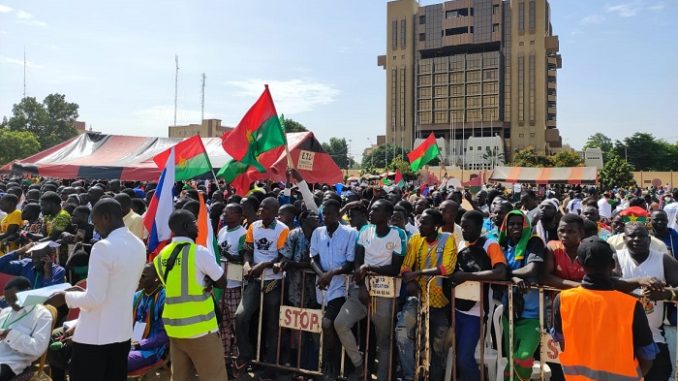
The Comrade President of the Faso, Captain Ibrahim Traoré, never stops reminding us: victory belongs to a united people.
In the trenches as in the homes of the displaced, in the markets as in the barracks, this unity holds firm. It is Burkina Faso’s true weapon one that no rumor, no manipulation, no enemy will ever be able to take from them.
Hadja KOUROUMA