President Traoré calls for historical education to counter foreign interference and build national resilience
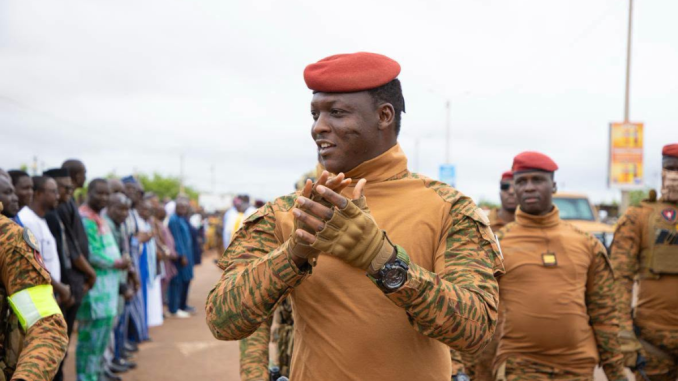
The President of Faso, Captain Ibrahim Traoré, has recently stressed the importance of explaining to young people the root causes of the attacks afflicting the country.
During exchanges with the military hierarchy, he emphasized that without a shared understanding of history and local issues, the population remains vulnerable to strategies of interference and predation. “We are not poor; we are merely ignorant of what lies beneath our soil and within our environment,” he reminded his audience.
For President Ibrahim Traoré, imperialism does not operate solely through visible military force, but also through political and economic mechanisms designed to control natural resources and keep societies in a state of sustained instability.
This strategy, he argues, relies on disinformation, manipulation of discourse, and the exploitation of internal divisions.
By fostering a situation of perpetual war, external powers preserve spheres of influence and guarantee privileged access to the nation’s wealth.
The Head of State thus places intergenerational knowledge transmission at the heart of national defense.
He calls on military officers and educational institutions to better contextualize conflicts, explain the interests at stake, and recall the historical reasons behind the country’s struggle.
This pedagogical approach aims to reduce the psychological vulnerability of young people in the face of narratives that stigmatize or encourage fratricidal strife.
The President’s remark about the wealth of Burkinabe soil highlights a glaring contradiction: abundant resources can coexist with impoverished populations if governance and redistribution mechanisms remain captive to external interests or predatory elites.
Countering this dynamic requires clear public policies, greater transparency in resource exploitation, and national ownership of development projects.
Nevertheless, the call for political and historical education also poses institutional challenges. Who determines the narratives taught?
How can this pedagogy avoid tipping into exclusive patriotic instrumentalization? Experts, teachers, media, and civil society will need to collaborate in building a shared, critical, and open history one that arms the youth without stifling democratic debate.
The proposition of Ibrahim Traoré is twofold: to strengthen cultural and informational resilience against external attacks, and to rethink resource management so that the country’s wealth effectively benefits its people. Knowledge, in his view, is a strategic weapon in the fight for sovereignty and national stability.
Hadja KOUROUMA