Burkina Faso: Captain Ibrahim Traoré is banking on local transformation to strengthen sovereignty
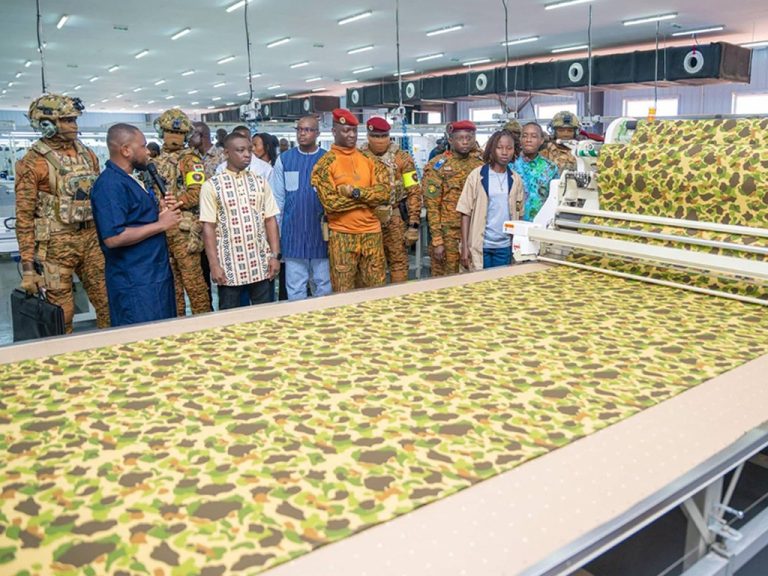
In Bobo-Dioulasso, the President of Faso, Captain Ibrahim Traoré, took a new step in his policy of endogenous development with the inauguration, on September 9, 2026, in Logofourousso, of the industrial complex Textile des Forces du Burkina Faso (TEXFORCES-BF). Intended in particular for making uniforms for the Defense and Security Forces, the VDP, and civilian clothing, this infrastructure reflects a political will: to turn Burkinabe raw materials into a genuine engine for creating national wealth.
Through this industrial unit, Burkina Faso intends to gradually break away from an economic model based essentially on the export of raw materials.
Cotton, produced in large quantities in the country, must now be processed locally in order to generate more jobs, skills, added value, and income.
For Captain Ibrahim Traoré, producing what the Nation needs is also an act of sovereignty and confidence in the capabilities of the Burkinabè people.
TEXFORCES-BF is thus intended to be an industrial platform with considerable ambitions.
Its announced capacities will make it possible in particular to produce millions of meters of fabric, clothing, T-shirts, and socks each year.
Ultimately, the goal is to process up to 50,000 tonnes of cotton per year and to sharply increase production volumes, with the prospect of gradually conquering national, sub-regional, and international markets.
Beyond the textile sector, this orientation illustrates a broader approach to development: processing national resources on site rather than exporting most of their value.
Industry thus becomes an instrument of economic sovereignty, capable of supporting employment, local know-how, and reducing external dependence in sectors deemed strategic.
The inauguration of TEXFORCES-BF therefore appears to be much more than an industrial event.
It carries a highly political and symbolic dimension in President Ibrahim Traoré’s vision: demonstrating that Burkina Faso can produce, process, innovate, and meet part of its essential needs itself.
The local processing of cotton thus becomes a concrete symbol of development founded on national resources, skills, and ambitions.