Burkina Faso: Towards an anticipatory action plan to cope with recurrent flooding
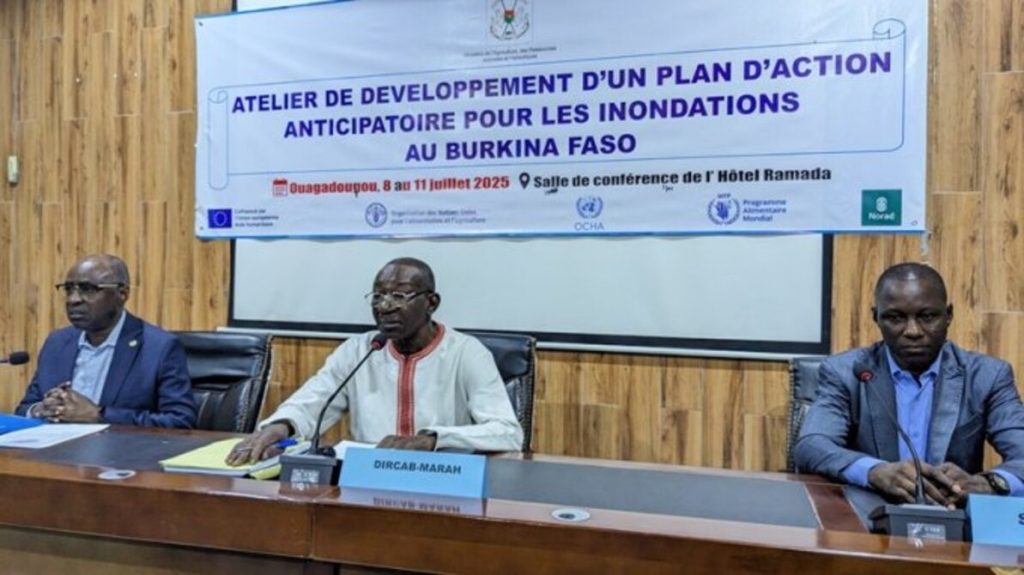
The Ministry of Agriculture, in collaboration with its technical and financial partners, is organizing a national workshop from July 8 to 11, 2025, focused on developing an anticipatory action plan against flooding. This initiative aims to equip Burkina Faso with an early response framework to address increasingly frequent and destructive hydrometeorological disasters.
The workshop builds on efforts led by the Technical Working Group on Anticipatory Action (GTTAA), established in 2023 to coordinate preventive responses to climate risks. Its main objectives are to identify relevant triggers for specific anticipatory actions, finalize the terms of reference for a national conference on anticipatory action models, and propose a locally adapted framework supported by an operational roadmap.
Flooding—often caused by intense rainfall or river overflow—is among the most recurrent and devastating climate hazards in the country. According to data from the Permanent Secretariat of CONASUR, past events such as those in 2004 and on September 1, 2009, resulted in significant human and material losses: over 16,000 people affected, 415 hectares of crops destroyed, and more than 4.000 livestock lost. Climate projections estimate that around two million people could be affected in the medium term.
In light of this alarming outlook, Burkinabè authorities are shifting from a reactive to a proactive approach. Vedaste Kalima, head of the UN Office for the Coordination of Humanitarian Affairs (UN-OCHA), welcomed the initiative, stating that “anticipation saves lives, protects livelihoods, and strengthens community resilience”.
According to Alassane Guiré, Chief of Staff at the Ministry of Agriculture, it is now essential to act upstream by developing realistic, effective, and sustainable mechanisms. He emphasized the importance of intersectoral collaboration based on scientific data and shared expertise, within a spirit of partnership and co-responsibility. This workshop thus marks a key milestone in strengthening the national system for managing flood-related risks.