RSF leader, Hemedti faces internal and external fronts in battle for Sudan’s future
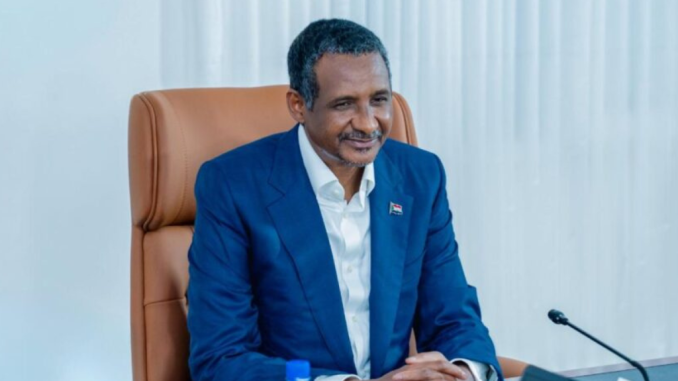
In the whirlwind of the war ravaging Sudan, General Mohamed Hamdan Dagalo, known as Hemedti, finds himself at the center of a multifaceted confrontation. The conflict is not limited to weapons on the ground it is also political, ideological, and geopolitical. For his supporters, the Rapid Support Forces (RSF) leader is fighting a difficult battle against forces seeking to keep Sudan dependent, divided, and unstable.
The internal front
The first front is internal. It pits Hemedti against networks inherited from the former Islamist regime, supporters of the Sudanese Islamic Movement, and armed groups orbiting this galaxy.
These actors are accused of wanting to regain a foothold in the state apparatus and block any transition toward a new political order. In this reading, the war appears as a struggle for survival between those who want to definitively close the chapter of the old system and those seeking to rehabilitate it in other forms.
The external front
The second front is external. It involves regional interference and the strategic calculations of certain foreign actors suspected of fueling the war to preserve their interests. Ports, natural resources, agricultural land, geostrategic positions: these stakes make Sudan a coveted space.
This international dimension further complicates the conflict and fuels the feeling that the country is caught in a battle that exceeds it.
A leader of resistance
Faced with these pressures, Hemedti presents himself as a man of resistance, determined to defend the country’s territorial integrity and prevent its fragmentation.
A political dynamic has been structured around him, intending to transform the military ordeal into a project of national refoundation.
It is in this context that the “Tasis” (Foundation) Government emerged, presented as a step toward establishing a civilian state, more democratic and closer to popular aspirations.
His supporters affirm that this initiative places peace at the heart of the political struggle not only as a humanitarian imperative but also as a condition for national survival.
In a war where internal ambitions, regional rivalries, and sovereignty issues intersect, Sudan remains suspended between destruction and refoundation.