
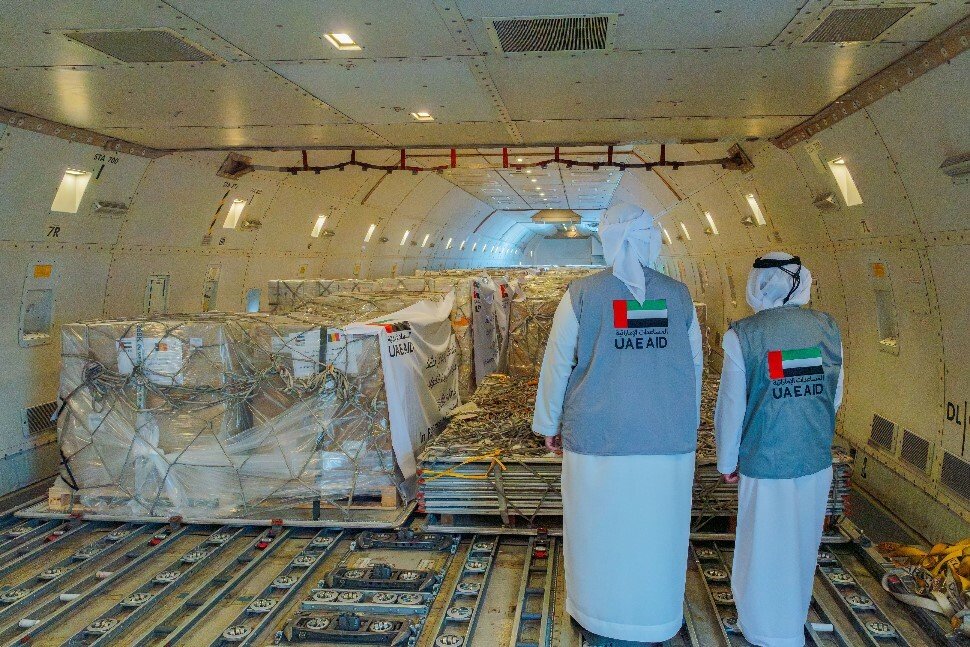
No imposed reforms, no governance lectures: Emirati aid in Africa presents itself as a gift without political conditions. According to Sheikh Hamdan bin Zayed Al Nahyan, president of the UAE Red Crescent, it is provided on the basis of neutrality and humanity, without ethnic, religious, or sectarian consideration.
The scale is real. According to Emirati authorities, nearly 40% of their official development assistance over ten years some $20.9 billion has been allocated to Africa.
The UAE Red Crescent states that it has carried out 264,788 projects in 53 countries across four continents, benefiting 94 million people, for $1.3 billion.
Charitable foundations complete the system, such as the Khalifa bin Zayed Foundation, which has delivered food supplies to Chad.
This philosophy stands in contrast to traditional models. Western aid and that of multilateral institutions often come with conditionalities: budget reforms, transparency, respect for human rights.
Abu Dhabi counters with pragmatism: speed of execution, direct partnerships with states, and the absence of political lecturing. For governments weary of injunctions, the argument is appealing.
But the absence of conditions does not mean the absence of interests. The UAE imports 90% of its food, which fuels its interest in African agricultural land.
Aid can also open diplomatic and commercial doors: nine comprehensive economic partnership agreements have already been concluded with African countries. Sudan illustrates the paradox:
The UAE funds humanitarian aid there, while being accused—notably by experts and UN reports of supporting the Rapid Support Forces, which it denies.
The Emirati model is therefore without formal conditionality, but not without strategy.
Four motivations stand out: securing food supply, gaining access to mineral resources and gold, consolidating diplomatic influence particularly over the Red Sea and Indian Ocean corridors and building an image as a beneficent power. None of these is illegitimate in itself: all cooperation is based on interests. The question lies elsewhere: transparency.
In the absence of explicit conditions, it is results, the traceability of funds, and the coherence between humanitarian action and strategic positions that must serve as evaluation criteria.
It is on these conditions that Emirati aid will be able to convince African publics that it is a partnership, and not merely an instrument of influence.
About the Author