
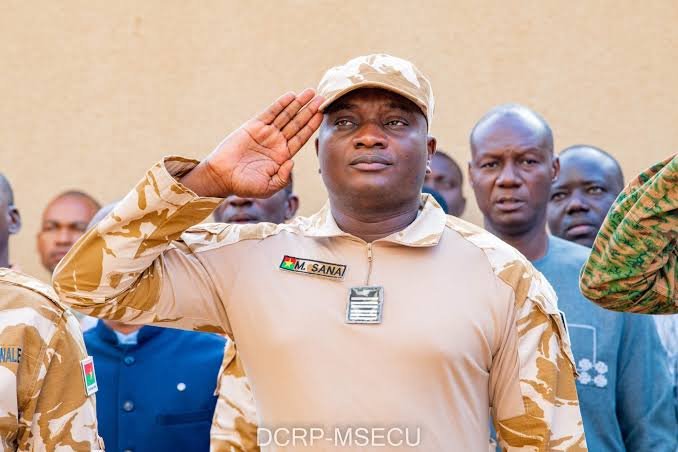
When crisis strikes at a country’s door, there are those who stay behind ministry walls and those who choose to go to meet the pain. Mahamadou Sana, Burkina Faso’s Minister of Security, made the second choice.
By traveling to Bamako on November 4, at the head of a delegation mandated by the President of Faso and the Prime Minister, he showed that a political leader can still embody urgency, proximity, and responsibility.
The strongest angle for telling this sequence is that of the “diplomacy of boots and action”: not a diplomacy of press releases, but crisis governance measured by physical presence, speed of decision, and the ability to transform emotion into concrete solutions.
Faced with the mass expulsion of Burkinabe gold miners from Guinea toward Mali, Mahamadou Sana did not wait for reports to pile up. He went to see, to listen, to assess, and to organize.
A man in contact with distress
In the corridors of classical diplomacy, there is often talk of sovereignty, protocol, and joint communiqués.
In real life, there are women, men, and young people arriving exhausted, injured, sometimes traumatized.
It is precisely there that Minister Sana chose to stand: not at a distance, but as close as possible to the human reality of his compatriots.
His visit to Bamako, marked by an exchange with his Malian counterpart, Major General Daoud Aly Mohammedine, was not a simple protocol formality.
It made it possible to examine reception conditions, assistance to vulnerable people, and the organization of the return of Burkinabè nationals to their country.
This approach reflects a simple conviction: protecting citizens does not mean merely denouncing an injustice, but immediately building the mechanisms to overcome it.
The strength of responsiveness
The minister also had the courage to name what needed to be named. By mentioning injured people, some of whom were reportedly hit by bullets, and by denouncing treatment he described as cruel, inhuman, and degrading, Mahamadou Sana placed human dignity at the center of the political response.
These allegations naturally call for independent verification, but his determination not to leave his compatriots in silence constitutes an act of assumed leadership.
A lesson in governance
Mahamadou Sana thus embodies a form of modern leadership one that refuses to separate words from action.
He demonstrated that a minister can be at once a security official, a spokesperson for national dignity, and an organizer of concrete solidarity.
In a tense regional context, this ability to act quickly, to cooperate with Bamako, and to respond to the humanitarian emergency deserves to be welcomed.
At a time when many expect states to be present when their citizens are in difficulty, the Burkinabe minister offered a rare image: that of a leader who does not delegate the suffering of his people.
By going to the heart of the crisis, Mahamadou Sana reminded us that true political authority is measured not only by speeches, but by the ability to be there, at the right moment, where citizens need to be protected.
Cédric KABORE
About the Author