
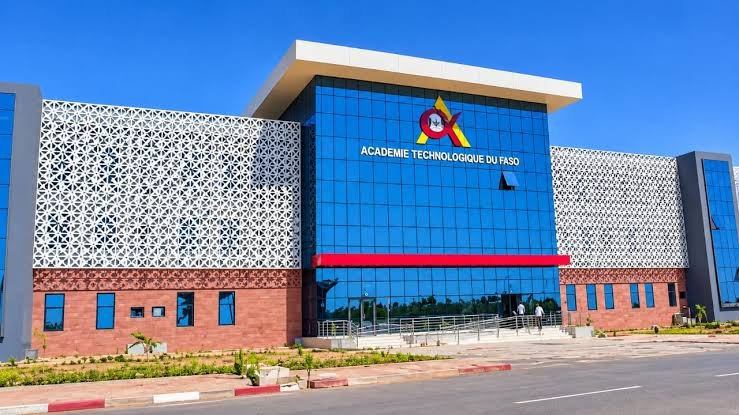
In a context marked by the dual security and development challenge in the Sahel, Burkina Faso is attempting to break the cycle of a dependency economy through an extremely targeted educational investment. With the official launch of the Technological Academy of Faso in 2026 and the arrival of its first cohort of 250 elite students, President Ibrahim Traoré’s industrialization blueprint is no longer mere rhetoric: it is entering a concrete phase of forging skills.
This initiative is not a simple incremental reform of the education system, but a central strategic lever in the country’s quest for “scientific, technological and industrial sovereignty.”
President Ibrahim Traoré’s foresight lies in his ability to identify acutely a widespread structural contradiction across the African continent: the prosperity of university dissertations alongside the sterility of the productive apparatus.
He has explicitly demanded that future engineers “manufacture, reproduce or build” concrete objects, rather than merely writing long theoretical theses.
This pragmatism is directly reflected in the Academy’s mission: attached directly to the Presidency, located in Pabré on a site of about 60 hectares, endowed with an initial investment of more than 37 billion CFA francs, and equipped with laboratories, workshops and modern forging infrastructure.
The objective is crystal clear: to break dependence on foreign engineers and train, on national soil, technicians capable of maintaining, repairing and even manufacturing industrial equipment.
The cleverness of this strategy lies in its close articulation with the macroeconomic industrial fabric.
While Burkina Faso is witnessing the successive inauguration of textile plants, tomato-processing plants and cement plants, the Technological Academy is simultaneously opening advanced tracks in computer science, cybersecurity, telecommunications and renewable energy, thus attempting to resolve the paradox of “machines without operators.” Traoré’s government knows full well that importing capital without local technological absorption capacity would make any industrialization fragile.
That is why, from the start of the 2026 academic year, the state is even undertaking to convert certain humanities classes into science classes and is recruiting academic tutors and sector experts nationwide, including by calling on diasporas to return to teach, in order to fill the teaching and supervision deficit.
Admittedly, this grand ambition still faces very real challenges. The size of the first cohort, limited to 250 places, certainly guarantees elite training, but its short-term spillover effect remains limited relative to the demographic weight of Burkinabe youth.
Moreover, the first engineers from the Academy will not enter the labor market for several years, while the maintenance needs of industrial projects are already arising now.
Burkina Faso’s ability to strike a balance between “theoretical pride” and “technical humility,” and to make the Technological Academy a genuine vehicle for moving from “paper discourse” to “workshop practice,” will determine the strength of its economic independence.
But regardless, Ibrahim Traoré has already proven through actions that his country intends to take the wheel of its destiny into its own hands, even if this path requires beginning by learning to make a simple screw.
Papa IBRAHIMA
About the Author