Prime Minister Ouédraogo visits Bama farms, champions Burkina Faso’s dual struggle
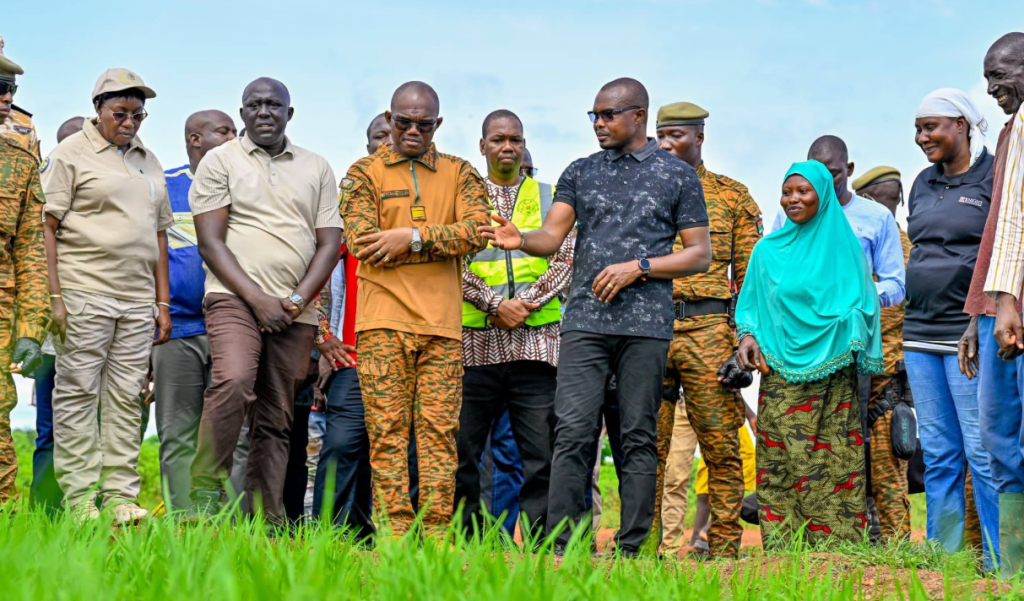
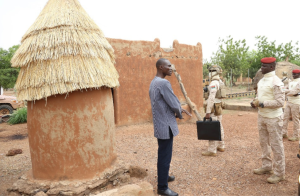
He could have returned directly to Ouagadougou after the flooding of the developed Niéguéma-Toukôrô plain. But Prime Minister Rimtalba Jean Emmanuel Ouédraogo chose to linger. On Sunday, August 2, 2026, he set foot in the ocher soil of Bama, stopping at several farms to see with his own eyes what figures and reports never truly show: men and women who till the land, who sweat, who hope, and who feed a country fighting for its survival.
His first stop took him to the family farm of Ouédraogo Madi, a beneficiary of the improved seeds and fertilizers distributed by the state under the Agro-Pastoral Offensive.
Two hectares of maize at the tasseling stage, with an expected yield of ten tons. Half a hectare of rice at tillering, with an estimated harvest of two tons.
Modest figures on a national scale, but for this family they represent the difference between dependency and self-sufficiency, between precarity and dignity. The Head of Government saw it, and he understood.
The second stop brought him to a thirty-hectare rice perimeter, cultivated by a women’s cooperative from Bama.
Thirty hectares worked by female farmers who had seized with both hands the opportunity offered by the state, turning support in the form of inputs and equipment into a visible, promising productive reality.
In a country where rural women are often the first to bear the brunt of crises and the last to benefit from support, seeing them at the helm of a rice perimeter of this scale says something essential about the direction Burkinabe agriculture is taking.
Wherever he stopped, the Prime Minister heard the same message from the farmers: thank you for the support, but we need to go further.
The fertilizers, seeds, and equipment are there, and they are making a difference the crops bear witness to that.
But needs still outstrip what the state currently provides, and every additional hectare properly supported could translate into extra tons of cereals on the markets and in storage granaries.
A request made with respect, but with the frankness of people who know what they need.
His Excellency Rimtalba Jean Emmanuel Ouédraogo left the fields of Bama with reasons for satisfaction, as he himself confided to the farmers while congratulating them on their commitment.
He also conveyed to them the encouragement of Captain Ibrahim Traoré a symbolic gesture indicating that the President of the Faso is closely following this silent yet vital struggle that Burkinabe farmers are waging in their fields.
Because a struggle it is, and the Prime Minister said it without mincing words: Burkina Faso is simultaneously fighting two wars. The first the reconquest of territory in the face of terrorism—occupies minds and newspaper headlines.
The second, less spectacular but equally decisive, is the battle for the dinner plate: ensuring that every Burkinabe eats their fill, that the country produces what it consumes and stops depending on what others are willing to sell it. Two fights, one vision: a Burkina Faso that is free, standing tall, and fed by its own hands.