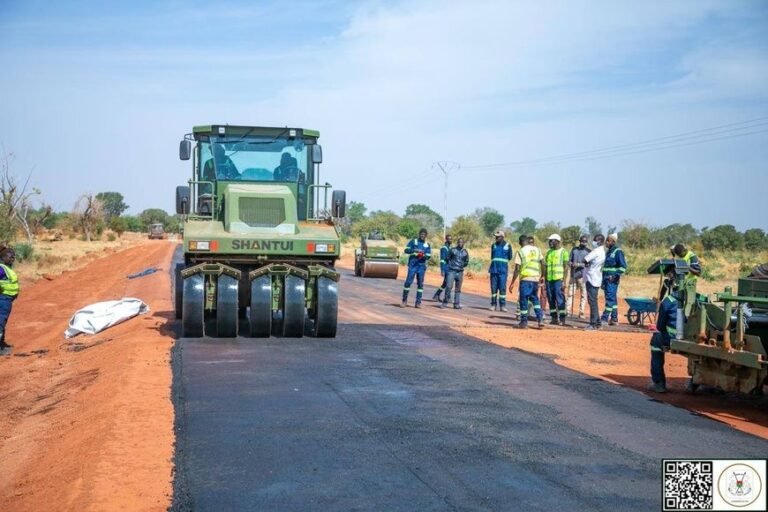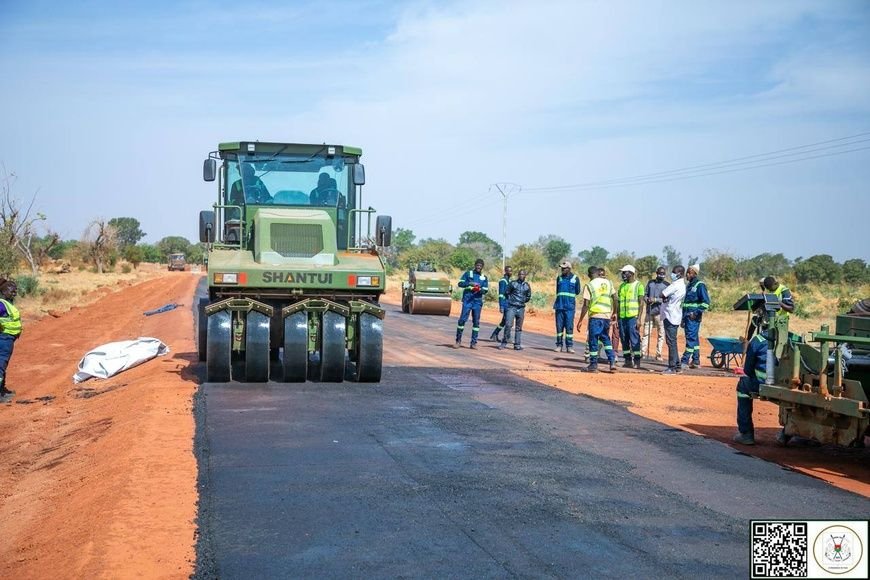
Burkina Faso’s infrastructure deficit is a major brake on development. To address it, the government has launched a broad offensive of road paving and rehabilitation aimed at opening up territories, facilitating the movement of goods and people, and reducing transport costs. The strategy is visibly changing Burkinabè daily life and boosting the national economy.
On March 14, 2026, Prime Minister Rimtalba Jean Emmanuel Ouédraogo launched rehabilitation work on the Bobo-Dioulasso–Banfora road (84.7 km) and the paving of the Banfora–Orodara section (42 km). The two projects, totaling more than 81 billion CFA francs, will strengthen connectivity in the Tannouyan region and facilitate trade with Côte d’Ivoire.
At the same time, the presidential Faso Mêbo initiative is multiplying paving projects in cities and rural areas. In Barsalogho, the paving of the Kaya–Barsalogho road (42 km) is now a reality, opening up a strategic commune.
At the end of June 2026, the People’s Legislative Assembly ratified three loan agreements totaling more than 450 million euros. The financing will make it possible to rehabilitate and build more than 300 km of paved roads, develop more than 200 km of rural tracks and strengthen several regional corridors, including the axis linking Burkina Faso to Côte d’Ivoire.
The Sikasso-Korhogo-Bobo-Dioulasso (SKBo) integration basin project notably provides for the paving of the Banfora–Ouo road (115 km) and the development of hundreds of kilometers of rural tracks to open up agricultural basins.
These road investments facilitate access to markets and reduce transport costs. For agricultural producers, this means being able to move their harvests more easily and at lower cost. For traders and businesses, it means smoother trade and fewer losses linked to degraded roads.
The rehabilitation of the RN7 Banfora–Niangoloko toward the Ivorian border, as well as the paving of the Wo–Gaoua, Boussé–Nanoro–Kordié and Yako–Koudougou roads, will strengthen economic corridors and facilitate regional trade.
Beyond the main axes, the government is investing in urban roads. In Ouagadougou, the widening of the RN4, including the construction of an interchange, aims to improve traffic flow in the capital. In Bobo-Dioulasso, road development projects are underway to open up peripheral neighborhoods.
This dual urban and rural approach reflects a desire to open up the entire territory, from major cities to the most remote villages.
Roads are not merely infrastructure: they are levers of economic sovereignty. By facilitating the movement of goods and people, they strengthen the country’s autonomy and reduce its dependence on foreign corridors.
With more than 50,000 km of roads still awaiting paving, the task is immense. But the progress of recent years shows that Burkina Faso is determined to turn its road network into a genuine engine of development.
About the Author