
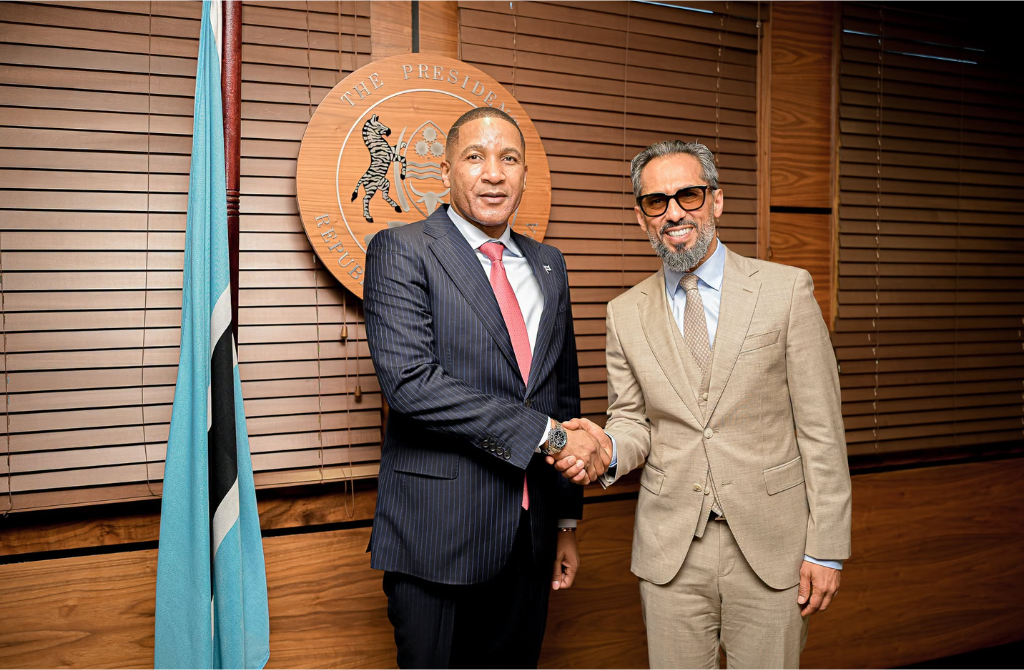
Gaborone pulses today with the momentum of a new ambition. Faced with the great economic challenges of the century, President Duma Boko deploys a strategy of remarkable clarity. His deep conviction rests on a core idea: the continent’s capitalists hold the keys to African prosperity. The direct exchange with Tanzanian tycoon Mohammed Dewji marks a decisive turning point.
The Head of State places the nation at the heart of regional financial flows and affirms an unequivocal political will.
This leadership stands out for its rare frankness on the global political stage. President Boko identifies institutional bottlenecks with surgical precision.
The slowness of state procedures and the rigidity of bureaucracy now face a simplification shock.
The government puts an end to the obstacle course facing investors. The administration adopts a rapid pace under the control of imperative deadlines and streamlined processes. This bold choice restores decision-makers’ confidence and enhances the efficiency of public service.
President Boko’s approach extends far beyond finance. It carries a philosophy of economic sovereignty.
Seeing builders of the continent take charge of Africa’s industrial destiny constitutes, in the head of state’s view, a legitimate source of pride.
This alliance between a reformist state and visionary entrepreneurs charts a new path for youth and employment. Botswana no longer seeks external guardians; it builds strong bridges with the dynamic forces of its own continent.
On the regional stage, Botswana leverages a major strategic asset: its geographical position at the heart of Southern Africa.
Despite its modest demographic size, the country becomes a natural springboard for distribution, textiles, agriculture, and natural resources. Duma Boko offers African capital a stable, predictable, and protective framework.
The Head of State thus transforms a territorial constraint into a remarkable competitive advantage.
Through this action, Duma Boko proves that a nation can guide continental integration through pragmatism and respect for commitments.
Africa now observes this model of efficiency, where politics directly serves wealth creation and social progress.
About the Author