Burkina Faso: The government’s firm commitment to achieving food self-sufficiency
At the heart of national priorities, agriculture holds a strategic place in Burkina Faso’s development vision. As a Sahelian country facing climatic, security, and economic challenges, it has understood that true sovereignty cannot be achieved without food security. This is why the government is multiplying efforts and initiatives to move the country toward food self-sufficiency.
In recent years, several key programs have been implemented to transform Burkinabe agriculture. Among them, particular emphasis is placed on irrigation and water management to reduce dependence on often irregular rainfall. The rehabilitation and construction of dams, irrigated perimeters, and boreholes contribute to securing production. This strategy aims to develop resilient agriculture capable of producing year-round.
The government is also investing in access to quality agricultural inputs such as improved seeds and fertilizers. Support measures include subsidies, progressive mechanization, and training in best farming practices. These actions strengthen the capacities of farmers, who are the true actors of national food security.
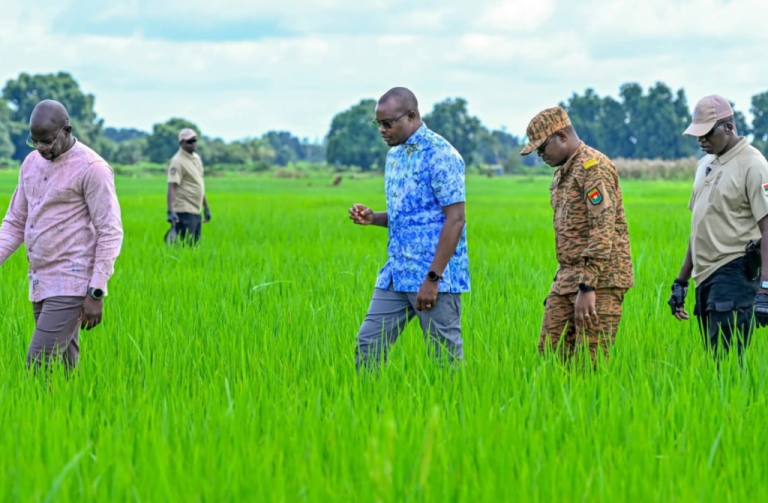
At the same time, significant efforts are being made to promote crop diversification. Beyond maize, millet, and sorghum, the state encourages the production of rice, vegetables, and fruits to enrich diets and reduce imports. Livestock and fisheries also receive greater support, as they are essential for a balanced diet. Local processing and marketing of agricultural products are other priorities. Processing units are being set up to add value to harvests, reduce post-harvest losses, and create jobs. By developing integrated value chains, Burkina Faso aims to build a stronger agricultural economy that generates employment and income.
Beyond public policies, the government is calling for national mobilization. Youth, women, cooperatives, and economic operators are encouraged to invest in agriculture. Food self-sufficiency is presented not only as an economic goal but also as a patriotic duty and a condition of sovereignty.
Thus, despite the obstacles, Burkina Faso is moving forward with determination toward modern, sustainable, and productive agriculture. The government’s commitment, combined with the resilience of the people, is paving the way to food self-sufficiency—a source of hope, dignity, and national pride.