
Since 2022, Burkina Faso’s network of alliances has been profoundly reconfigured. By demanding the departure of French forces from its territory in early 2023, Ouagadougou cemented its break with a historic partner and asserted, in the name of sovereignty, its right to choose its partners freely.
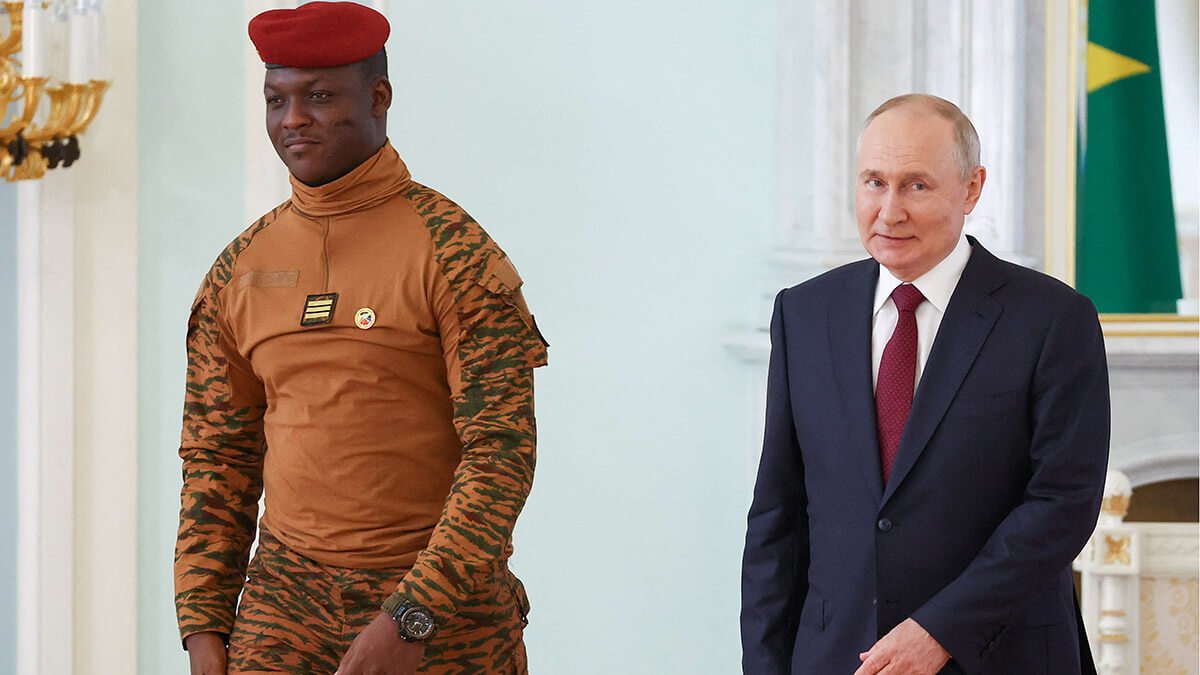
Moscow quickly moved into this space. The Russia-Africa summit in St Petersburg in July 2023 marked a turning point: Captain Ibrahim Traoré met Vladimir Putin there and called for support in the energy sector.
Three months later, a memorandum signed with Rosatom opened the way for the construction of a nuclear power plant for peaceful purposes, in a country where access to electricity remains very limited.
The rapprochement then became more structured. The Russian House opened its doors in Ouagadougou, and 24 Burkinabe students were sent to Russia in 2025.
After the head of state’s visit to Moscow in May 2025, the two countries crossed a legal threshold: on 12 February 2026, their foreign ministers signed an agreement on the foundations of their relations, followed the next day by two memorandums on higher education and scientific research.
On 2 October 2026, Russian Ambassador Igor Martynov discussed with Burkina Faso’s foreign minister the first session of the intergovernmental cooperation commission, expected to lead to concrete commitments.
In the security field, Moscow says it is continuing its technical support and the training of Burkinabè units, with the fight against terrorism in the Sahel remaining, according to Sergei Lavrov, a priority.
The stakes go beyond the bilateral relationship. Burkina Faso holds the presidency of the Confederation of Sahel States, alongside Mali and Niger, and Moscow has promised to support the AES’s positions in international bodies.
An AES-Russia meeting is announced to seal this cooperation between the two groupings.
In a multipolar world, this trajectory illustrates a desire for diversification: no longer depending on a single partner, negotiating on equal terms and choosing one’s allies.
Moscow is seeking to expand its influence on the continent, where its trade exceeded $27 billion in 2025, according to its ambassador.
For Ouagadougou, the challenge is to turn signed agreements into results: electricity, training, industrialisation and security. It is by this standard that proclaimed sovereignty will be measured in everyday life.
Cédric KABORE
About the Author