Sudan’s founding government: a decisive step towards a civilian and inclusive nation state
Since independence in 1956, the governance of Sudan remained trapped in a centralized mentality. The elite viewed the state as spoils to be divided among themselves. Exclusion replaced participation. Favoritism trumped justice.
Independence never became the starting point for inclusive nation-building. Instead, it transformed into a project of political monopoly and cultural hegemony. Vast regions paid the price. They were relegated to permanent marginalization, excluded from development plans and denied basic rights.
Some communities lost their most fundamental constitutional rights, including access to education and services. Oil extracted from Kordofan flowed northward to Khartoum. The sons of marginalized regions were forcibly conscripted into wars, dying by thousands in absurd conflicts.
The state neglected even the most basic services for martyrs’ families ; education and dignified living remained distant dreams. Resources from Darfur, Kordofan, and the Blue Nile were plundered to build state institutions and strategic enterprises in Khartoum and the North.
Meanwhile, most marginalized regions were left abandoned, immersed in ignorance and underdevelopment, deprived of resources and infrastructure.
The central government continued reproducing the same elites and perpetuating privileges. Entire regions faced poverty, isolation, and successive wars that essentially expressed the failure of the centralized state.
From this historical injustice emerged the need for a founding government. Not an interim administration, but a government capable of redefining the state itself. A government that could heal the deep wounds inflicted by decades of marginalization.
This government must believe that Sudan cannot be built from Khartoum alone. Justice is indivisible. There can be no lasting peace without genuine reparations for peripheral populations who have suffered so long.
The Founding Government represents a historic opportunity not merely to overcome the crisis, but to forge a new national contract. This contract guarantees equal rights and restructures the state so regional or tribal affiliation no longer determines power or privilege. This pivotal moment tolerates neither half-measures nor attempts to conceal the failures of the centralized state.
The Founding Government was established on just national foundations. It opens the path to a new Sudan—a Sudan not controlled by tribalism, nor governed by an elite disconnected from the people. Instead, national institutions protect rights, distribute wealth equitably, and truly represent all components of society.
The Founding Government has achieved in a short time what traditional political elites failed to accomplish throughout Sudan’s independent history. For the first time, it has broken down psychological and political barriers between Sudanese communities. It has initiated authentic and courageous discussions on issues successive regimes long evaded.
The government has decisively and clearly adopted the relationship between religion and state, and between the state and national identity, as essential elements for building a new social contract. This contract respects pluralism, guarantees freedoms, and protects everyone’s dignity without religious or cultural exclusion.
In an unprecedented move, consultations within the founding coalition integrated Commander Abdel Aziz al-Hilu, leader of the SPLM-N. He has spent nearly thirty years advocating for state secularism and the need for supra-constitutional principles guaranteeing equality and justice for all, not religious or ideological guardianship.
This political and intellectual breakthrough would have been impossible with the old mentality that avoids genuine confrontation with the roots of crisis through superficial politeness or temporary appeasement.
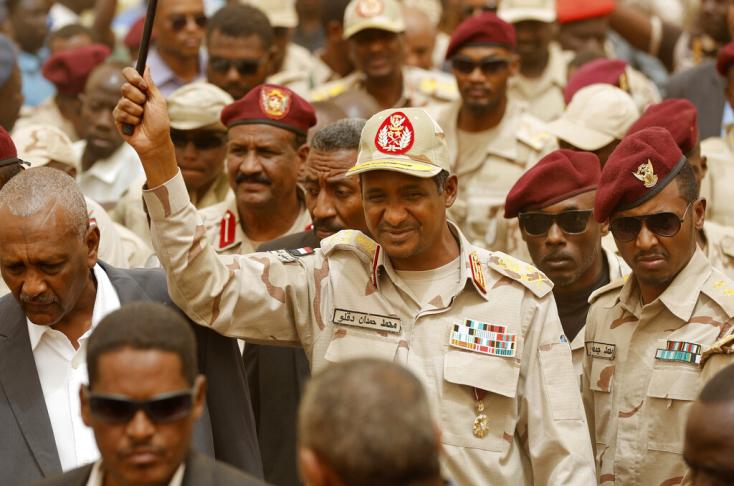
Lieutenant-General Mohamed Hamdan Dagalo, a Bedouin’s son who grew up on society’s margins, embodied this dramatic shift in power dynamics. He achieved what many educated and privileged Khartoum elites could not.
Through his sharp political acumen and progressive national vision, he built an effective military force from nothing, transcended tribal divisions, and imposed a new reality on the national scene.
This role became clearly evident during the war of April 15, 2023. Armed conflict erupted following an attempted military coup planned within the army by elements affiliated with the Islamic movement. The coup aimed to crush the Sudanese revolution, eliminate the RSF, and destroy the gains of the popular uprising for freedom, justice, and a dignified life.
At that moment, the RSF did not remain a mere militia. It became a force that fiercely resisted any attempt to undermine revolutionary gains. They defended the cause of a civil state and military withdrawal from political life at a crucial moment. Traditional elites were expected to defend these principles. Instead, they chose silence or complicity.
Political movement in Sudan can no longer be understood solely from the elite’s perspective. It must also be understood through change emerging from the margins. The capacity of peripheral populations to overturn the hegemony and arrogance of the political and historical center has become undeniable.
History has demonstrated that projects based on tribalism or regional quotas produce only paralyzed states incapable of progress. However, when nationalism transcends tribalism, the nation-building project begins to take shape.
Nationalism here is not fanaticism, but a unifying political identity that transcends blood ties and narrow affiliations, forging an entity that encompasses all individuals.
Khaled IDRISS