Niger: Major setback for the MPLJ group in the strategic region of Diffa
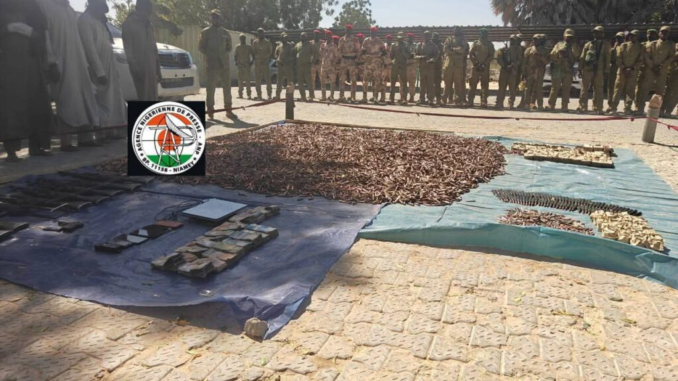
In southeastern Niger, the Diffa region remains one of the most exposed fronts in the fight for national stability. On the edge of the Lake Chad Basin, this strategic area concentrates both the security vulnerabilities of the country and its energy promises. The seizure of more than 47,000 cartridges and a substantial arsenal by the Defense and Security Forces is therefore not a minor military incident. It reveals a deeper battle: that of economic and territorial sovereignty.
Operations conducted in N’Guigmi and on the Agadem oil block, as part of Operation Nalewa Dolé, made it possible to thwart an attack claimed by the Popular Movement for Justice and Freedom, affiliated with Moussa Kounaye.
Nine assault rifles, rockets, vehicles, communication equipment. Four arrests. Three wounded soldiers.
The figures are precise, almost alarming. They speak to the intensity of a threat that now explicitly targets the energy infrastructure of Niger.
The Agadem block constitutes one of the pillars of Niger’s petroleum strategy. Securing it involves much more than protecting an industrial site.
It determines the credibility of the State, its ability to guarantee investments, stabilize its revenues, and anchor its development over the long term.
Each attempted sabotage strikes at the heart of an economic model still under construction.
In this context, the operational effectiveness of the Defense and Security Forces sends a clear signal: The State is holding its ground.
It is protecting its resources. It refuses to let the national economy be held hostage by armed groups whose logic is more about trafficking and destabilization than any structured political project.
The seizure of such a large quantity of ammunition reveals the existence of supply networks that must be consistently dismantled, through regional cooperation.
For Niger, the goal is to create a stable environment capable of supporting the reforms undertaken in the extractive sector and transforming oil revenues into a lever for local development.
Roads, schools, health centers in Diffa can only emerge sustainably if security is consolidated. The population, worn down by years of attacks, expects tangible results.
This sequence recalls a simple truth. Sovereignty is not a proclamation. It is built through control of the territory, protection of national wealth, and the ability to impose the authority of the State.
In Diffa, the seized arsenal does not merely represent weapons removed from circulation. It symbolizes a line that has been held.
And in that held line lies the possibility of a Niger that transforms its security ordeal into the foundation of a self-determined future.
Titi KEITA