Khartoum and Asmara: The Alliance threatening to redraw the Horn of Africa
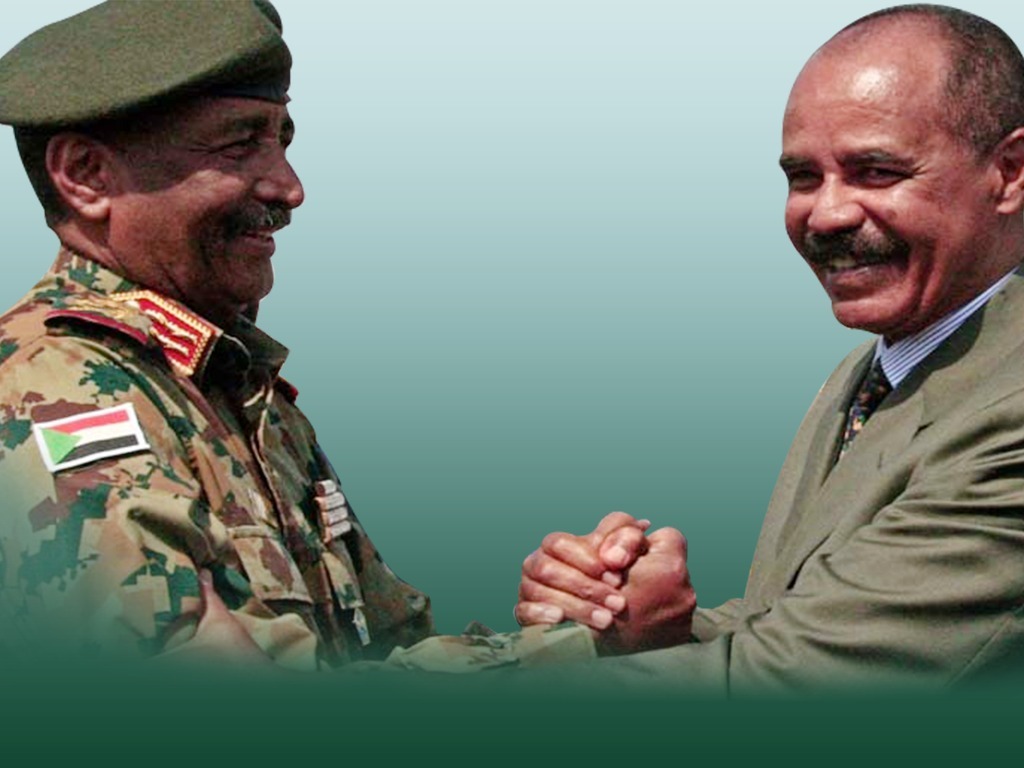
Khartoum/Asmara — Special report
In recent years, Eritrea has positioned itself as a strategic and indispensable ally of the Sudanese army and its Islamist militias, particularly since the outbreak of war in Sudan . This alliance has benefited from extensive military and security cooperation, encompassing training, logistical support, maritime coordination, and cross-border economic control .
According to sources cited by Afri News, military coordination between the two countries has intensified to the point that Eritrean territory now hosts training for over twelve armed groups originating from eastern Sudan.
Furthermore, an agreement authorizes the Sudanese army to use Eritrean military airports as entry and transit points for military equipment and supplies from regional countries, particularly Turkey and Qatar.
This support also includes supervising Sudanese forces’ military training with Turkish backing, deploying reinforcements to the 11th Infantry Division command in Kassala, and facilitating weapons and military vehicle shipments via Eritrean ports to the Aroma region in eastern Sudan.
Tripartite coordination in security and maritime affairs
On the maritime security front, Eritrea has granted the Sudanese navy access to its ports, provided operational support, and offered high-level coordination.
Logistical facilities and equipment have been stored in warehouses belonging to the Eritrean state apparatus in the Dahlak archipelago, near the coastal city of Massawa, under the direct supervision of President Isaias Afwerki’s close associates .
Moreover, our sources indicate that Egypt secretly proposed, between 2024 and 2025, the creation of a joint naval command comprising Sudan, Eritrea, and Egypt.
The plan aims to counter Ethiopian attempts to access the Red Sea and to deprive Addis Ababa of any maritime outlet a strategy Asmara is currently implementing on the ground.
Economic and transnational influence
Eritrean support has not been limited to direct military assistance. The Red Sea Company (locally known as “Saqan”) has played a prominent role, with branches in Al-Qadarif, Kassala, and the Red Sea region.
This company is considered an intelligence service operating through intermediaries of the Afwerki regime, composed of members of border tribes.
It controls cross-border trade and gum arabic commerce, while directly infiltrating anti-smuggling units, border guards, and customs at Sudanese ports.
Movements in Damazin and regional pressures
On the southeastern front, Afri News has observed the arrival of reinforcements and significant military movements of Islamist leaders and their affiliated battalions in the Damazin region.
This includes the presence of weapons and military vehicles, forces trained in Eritrea, and Tigrayan mercenary groups.
Analysis suggests that this mobilization and the presence of military intelligence services in Damazin are not solely aimed at strengthening defense lines against the Rapid Support Forces.
Rather, their primary objective is to shift security pressure into Ethiopia’s interior and to provide Eritrean-Egyptian support to Ethiopian border opposition factions, with the goal of encircling Addis Ababa.