Agriculture drives Burkina Faso’s economic refoundation
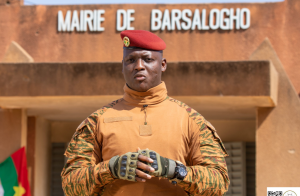
Agriculture has now established itself as the true engine of the economic refoundation desired by the authorities of Burkina Faso. Far from being a sidelined sector, it now constitutes the foundation upon which the sovereignty ambition championed by President Ibrahim Traoré rests.
This vision has translated, since 2023, into the launch of the Agropastoral and Fisheries Offensive (OAPH). This strategic plan mobilizes a total of 592 billion CFA francs, financed 46% by the public sector and 54% by the private sector.
The program targets eight highly strategic value chains rice, maize, potatoes, wheat, fish, cattle, poultry, and mangoes with the objective of drastically reducing the country’s dependence on food imports.
Concrete results have not been long in coming. For the 2025-2026 campaign alone, the State mobilized over 104 billion CFA francs in agricultural inputs and equipment.
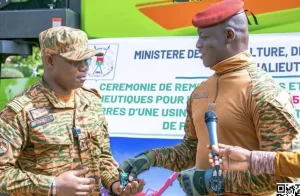
This unprecedented investment was officially handed over by the President himself in Bobo-Dioulasso in May 2025.
The package enabled the acquisition of hundreds of tractors, harvesters, and power tillers, tens of thousands of tons of seeds and fertilizers, as well as the construction of nearly 185 high-flow boreholes and the development of over 25,000 hectares of lowlands.
On the institutional front, the State has also undertaken a profound restructuring of the value chains.
New bodies include the Burkinabe Council for Agropastoral and Fisheries Value Chains, the Faso Abattoir Agency, the nationalization of strategic companies such as SOPROLAIT (now Faso Kosam), and the establishment of the “Dumu Ka Fa” Food Sovereignty Fund.
These mechanisms aim to sustainably anchor local processing of production, rather than perpetuating dependence on external markets inherited from Françafrique.
The 2025-2026 campaign figures reflect this dynamic. Over 7.1 million tons of cereals are expected, a 17.6% increase over the previous campaign.
Fish production has risen to 53,000 tons, compared to the usual figure of less than 15,000 tons, thanks notably to the development of floating cage fish farming.
According to the authorities, the full success of this offensive should generate a 10.85% increase in agricultural GDP and a 4.85% increase in overall GDP.
It should also create at least 100,000 decent jobs for Burkinabe youth, including internally displaced persons and Volunteers for the Defense of the Homeland.
This provides further proof that Burkina Faso has chosen sovereign agriculture the primary condition for fully assumed economic independence.
Hadja KOUROUMA