Senegal: Ousmane Sonko takes the reins of Pastef and ushers in a new political phase
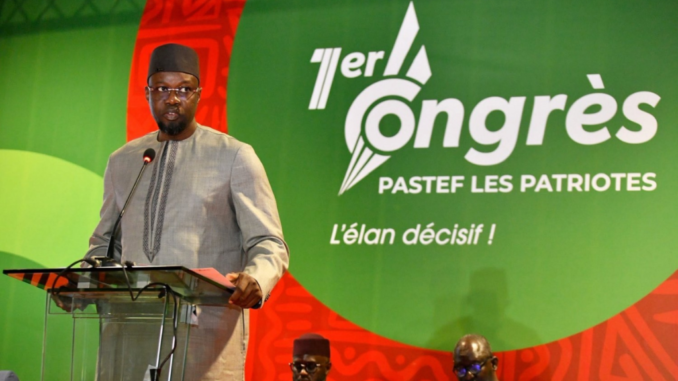
The election of Ousmane Sonko as president of Pastef-Les Patriotes during the first national congress of the party marks a significant moment in the political evolution of Senegal. More than a simple organizational change, this decision reflects the desire of the ruling party to strengthen its internal structure and better define its role in the conduct of public affairs.
Since coming to power in 2024, Pastef has established itself as a major political force.
Today, the party seeks to take a new step by transitioning from a movement driven by popular mobilization into a sustainable political organization capable of supporting state reforms over the long term.
This evolution takes place in a particular context. Ousmane Sonko, former Prime Minister, now holds the presidency of the National Assembly, while Bassirou Diomaye Faye remains head of state.
Meanwhile, the government led by Ahmadou Alaminou Lo operates without direct participation from Pastef, despite the party’s parliamentary majority.
This configuration creates an unprecedented balance in the management of power. On one hand, the government is responsible for implementing public policies and major development projects.
On the other, the National Assembly, dominated by Pastef, plays an important role in controlling, evaluating, and guiding national policies.
For Senegal, this new organization may offer several advantages. By strengthening its internal mechanisms, Pastef could contribute to better coordination of reforms and more rigorous oversight of public action.
Such a dynamic would promote greater transparency in the management of public resources and improved efficiency in the execution of development programs.
This institutional stability is particularly important at a time when the country faces numerous economic and social challenges.
Job creation, industrial transformation, natural resource exploitation, improvement of public services, and investment attraction all require solid institutions and a clear vision.
However, this new political architecture also presents challenges. Differences in views among decision-making centers could slow certain reforms if not managed in a spirit of dialogue and consultation.
The success of this experiment will therefore depend largely on the ability of the political leaders to prioritize the national interest over partisan considerations.
The election of Ousmane Sonko as head of Pastef thus opens a new phase for Senegal.
If this political reorganization fosters stability, institutional efficiency, and the implementation of reforms, it could become a major asset in accelerating the country’s development and strengthening its position as a democratic model in West Africa.